
Legal Insights

The first half of 2025 confirms a trend that businesses can no longer ignore: ADA website accessibility lawsuits are surging nationwide. According to the 2025 Mid-Year ADA Website Accessibility Lawsuit Report published by EcomBack, from January through June, 2,014 lawsuits were filed throughout many U.S. federal courts, marking a 37% increase year over year. The implications are profound for companies across industries, as litigation expands geographically, intensifies in volume, and exposes new legal risks.
Shifting Litigation Landscape
New York remains the most litigious state with 637 lawsuits (31.6%). Florida nearly doubled filings, climbing to 487 cases (24.2%). California rose to 380 cases (18.9%), led by Los Angeles County. Illinois emerged as a new hub, skyrocketing 746% year over year from just 28 cases in 2024 to 237 in 2025.
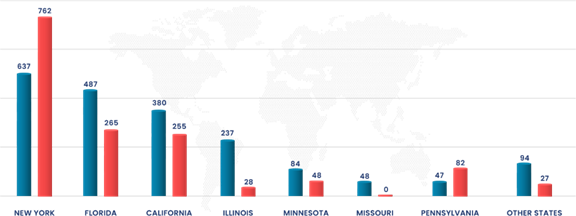
Bar chart comparing ADA website lawsuits filed in the first half of 2025 (blue bars) versus 2024 (red bars) across various U.S. states. New York and Pennsylvania show a decrease in lawsuits in 2025. In contrast, all other listed states — Florida, California, Illinois, Minnesota, Missouri, and “Other States” — experienced an increase in lawsuits. Source: EcomBack
Industries in the Crosshairs
Ten industries accounted for more than 90% of lawsuits filed in early 2025:
- Restaurants, Food & Beverage – 614 (30.5%)
- Fashion & Apparel – 580 (28.8%)
- Beauty & Skincare – 179 (8.9%)
- Healthcare – 144 (7.1%)
Together, restaurants and apparel alone made up nearly 60% of filings. This reflects both the high consumer engagement in these sectors and the persistent accessibility barriers in e-commerce environments.
Common Accessibility Barriers
The most common accessibility barriers cited in ADA lawsuits during the first half of 2025 include:
- Missing or incorrect image alt text
- Inaccessible forms and checkout processes
- Keyboard navigation failures
- Poor color contrast
- Improper heading structures and missing ARIA labels
- Inaccessible PDFs and documents
- Popups and overlays without accessible controls
The Widget Myth: Quick Fixes Don’t Work
A striking finding is that 456 lawsuits (22.6%) targeted websites that had accessibility widgets installed. Despite marketing claims, overlays and widgets are failing to protect businesses. The problem is now compounded by regulatory scrutiny. In 2025, the FTC reached a $1 million settlement with accessiBe, finding the company misled businesses by marketing its widget as a guaranteed compliance tool.
Platforms at Risk
No platform is immune:
- Custom-coded sites – 691 (34.3%)
- Shopify – 653 (32.4%)
- WordPress – 403 (20%)
- Magento & Salesforce Commerce Cloud – 207 combined (10.3%)
- Squarespace – 60 (3%)
These numbers show that compliance depends not on the platform itself, but on deliberate configuration and proactive auditing.
Global and Regulatory Pressure
The U.S. is not alone. Global regulations are accelerating:
- European Accessibility Act (EAA): Effective June 2025, this requires compliance across digital products in the EU.
- India’s Securities and Exchange Board of India (SEBI) mandate: Financial entities must now ensure accessible digital services.
- Los Angeles’ 2028 Olympic Accessibility Commitment: This embeds accessibility in infrastructure and digital platforms.
Domestically, the Department of Justice’s Title II rule takes effect in April 2026, requiring state and local governments to conform to Web Content Accessibility Guidelines (WCAG) 2.1 Level AA standards.
Key Takeaways for Businesses
- Litigation Risk is Growing: With over 2,000 lawsuits in six months, exposure is real and rising.
- Serial Filers Dominate: A handful of plaintiffs and firms are driving enforcement.
- High-Risk Industries Must Act: Restaurants, fashion, and e-commerce brands remain the most vulnerable.
- Widgets Are Not Enough: Code-level remediation is the only defensible strategy.
- Think Global, Not Local: Businesses serving international markets must prepare for compliance with EU and Indian regulations in addition to U.S. law.
Conclusion
The 37% surge in ADA website lawsuits this year is a wake-up call. Businesses must move beyond “check-the-box” approaches and embrace comprehensive digital accessibility strategies. With litigation intensifying and regulatory deadlines looming, the path forward is clear: prioritize accessibility now, or face mounting legal, financial, and reputational risks.
——————————————————————–
This Insight does not constitute written tax advice as described in 31 C.F.R. §10, et seq. and is not intended or written by us to be used and/or relied on as written tax advice for any purpose including, without limitation, the marketing of any transaction addressed herein. Any U.S. federal tax advice rendered by DarrowEverett LLP shall be conspicuously labeled as such, shall include a discussion of all relevant facts and circumstances, as well as of any representations, statements, findings, or agreements (including projections, financial forecasts, or appraisals) upon which we rely, applicable to transactions discussed therein in compliance with 31 C.F.R. §10.37, shall relate the applicable law and authorities to the facts, and shall set forth any applicable limits on the use of such advice.
